UGC agency vs direct clips: compare scope, cost, and workload
Compare a UGC agency, a direct creator, and a clip library by the work included. Use a responsibility checklist and a small pilot before committing.

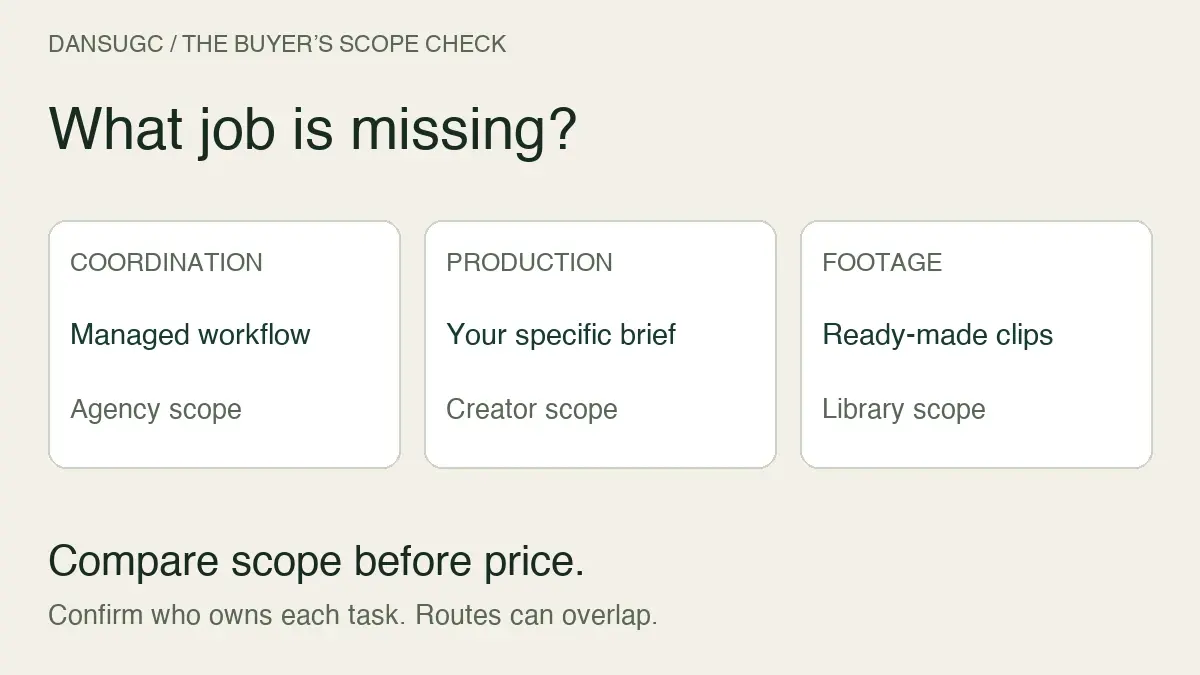
A UGC agency is worth considering when you need someone to coordinate creative direction, creator sourcing, production, and revisions—not just supply footage. Buying UGC clips directly can fit when your team already owns the message, product demonstration, editing, and review. Compare the work included in each route before comparing its price.
I run DansUGC, which sells creator footage, so I have a commercial interest in this comparison. My advice is not to replace every agency with a clip library. It is to identify the job you need done, then pay for that job rather than a label.
What are you actually hiring a UGC agency to do?
An agency proposal may combine several services. Do not assume that all of them are included just because the proposal says “full service.” Ask who owns each stage:
- Direction: audience, message, creative concepts, and scripts.
- Sourcing: selecting creators, confirming availability, and arranging product delivery.
- Production: recording the agreed footage and checking it against the brief.
- Post-production: editing, captions, audio, versions, and final exports.
- Coordination: approvals, corrections, licensing records, and delivery.
Your team still has responsibilities. Someone needs to supply accurate product information, approve claims, and give usable feedback. An agency cannot demonstrate a feature you have not explained or resolve conflicting feedback from three internal approvers without a decision-maker.
Ask for a named owner on both sides for each stage. That turns a vague service promise into a workflow you can evaluate. It also exposes whether your real bottleneck is footage, creative direction, or the time needed to manage production.
Agency, direct creator, or clip library?
These routes can overlap. A team can hire an agency for direction, commission a creator for product-specific footage, and use library reactions in the same production.
Choose an agency when coordination is part of the purchase
Consider an agency when you need a partner to manage several connected tasks and can verify that those tasks are in scope. For example, you might need creator selection, script development, shipping coordination, filming, editing, and a consolidated review process.
The useful question is not whether agencies are expensive. It is whether the proposal removes work your team cannot or should not own. Review the agency's process and relevant examples; a polished showreel does not tell you who handles a missed brief or a reshoot.
Agency capability varies. Some support ongoing creative volume; others specialize in a narrow production format. There is no sound basis for assuming every agency produces only a few videos or that direct footage always performs better.
Choose a direct creator when you can manage the brief
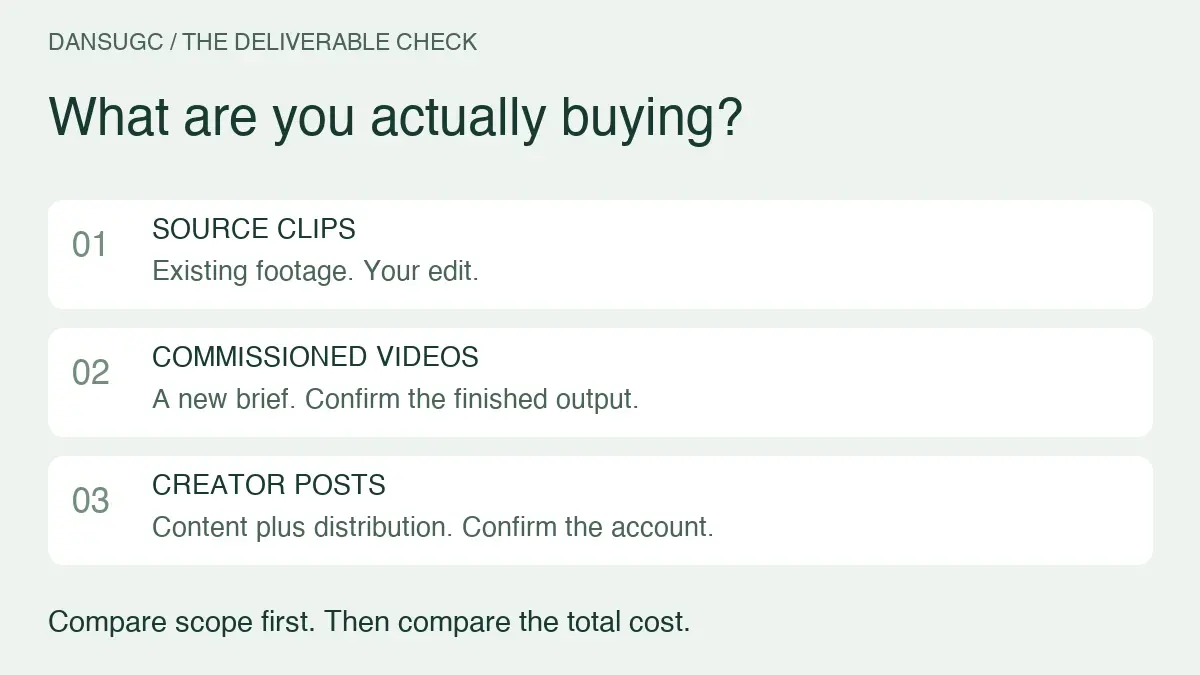
A direct creator arrangement can fit when you need original footage made for your product and can handle sourcing, communication, approvals, and delivery. Specify whether you need raw footage, finished edits, or both.
Do not compare a raw-footage quote with a managed finished-video proposal as though they include the same service. The UGC rate-card guide provides a way to describe scope before discussing price.
Choose a clip library when the missing piece is footage
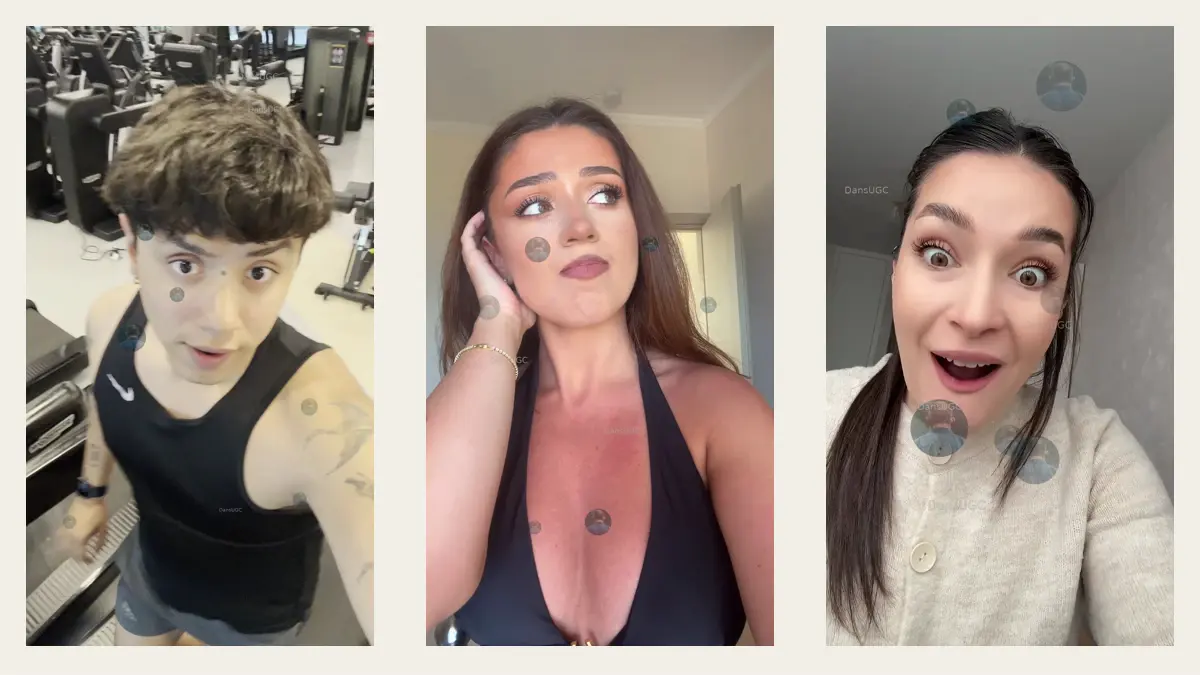
Ready-made reactions or B-roll can be useful when the message and product evidence already exist. Your editor might pair a reaction shot with a genuine product demonstration, an explanatory caption, and a relevant next step.
You still need to choose suitable footage, confirm permitted uses, assemble the edit, and review the result. A library clip is not automatically a finished advertisement, an exclusive asset, or a testimonial from someone who used your product.
For examples of what source footage contains, see the real UGC clip examples. Decide whether you need that ingredient or a production service around it.
How to compare UGC agency costs without inventing an average
We do not have a verified industry-wide agency price average to offer here. A useful comparison starts with equivalent deliverables and the full commitment.
Ask whether the quote is a fixed project, a per-deliverable arrangement, a recurring retainer, or a fee with an outcome-based component. Each can be reasonable. What matters is the scope, the conditions, and the work left to your team.
For a project, confirm milestones and acceptance criteria. For a per-video quote, define “video”: an original recording, a finished edit, or an export variation. For a retainer, confirm the term, capacity, unused allocation, and cancellation conditions. For an outcome-based agreement, ask exactly how the outcome is measured and which costs sit outside the fee.
The UGC pricing-model guide separates what you buy from how you pay. Keep those two questions separate here too.
Count the work your team still has to do
Compare the supplier fee, additional production costs, and your team's time. Keep distribution spend separate from production cost. Record scripting, editing, coordination, review, and corrections even when a founder does that work without sending an invoice.
For illustration only: suppose a managed package costs $1,200 and needs three internal review hours. A footage-only route costs $300 but needs 18 internal hours. At a hypothetical internal planning rate of $50 per hour, the totals are $1,350 and $1,200 respectively. These are invented planning inputs, not market prices or DansUGC quotes.
The footage-only option looks $900 cheaper before internal time and only $150 cheaper after it in this example. That still does not make the routes equivalent: confirm they produce the same accepted deliverables and permitted uses. If they do not, compare the differences explicitly rather than declaring a winner from the arithmetic.
Seven questions to send with your brief
Use these questions to make proposals comparable:
- What original footage, finished edits, and export variations will we receive?
- Who writes the scripts and supplies the product demonstration?
- Which creators are included, and how are replacements handled?
- What counts as a correction, a revision, or a new request?
- What uses are permitted, for how long, and are raw files included?
- What is the total commitment, including setup, renewals, and any applicable extras?
- Who approves the work, by when, and what happens if delivery misses the agreed brief?
These are practical purchasing questions, not a substitute for reviewing an agreement. Avoid assuming that “commercial use,” “ownership,” and “exclusivity” mean the same thing. Ask for the applicable terms in writing and get qualified advice where your intended use requires it.
A small pilot that tests the working relationship
Before committing to a large recurring order, agree on a paid pilot with representative work. Use your actual product information, expected format, feedback process, and acceptance criteria. Do not make the pilot so simple that it excludes the task you are most worried about.
For a hypothetical study app, that could mean one concept showing how a study session is organized, a real screen recording supplied by the brand, and a few clearly defined opening variations. The supplier should specify which parts it produces and which parts your team supplies. This is a planning example, not a client result or a guaranteed winning format.
Review whether the message is accurate, the footage fits, the text is readable, and the destination works. Track time spent clarifying the brief and correcting avoidable mistakes. Record whether the supplier followed the agreed process and whether your team gave feedback on time.
Evaluate production reliability separately from audience performance. A video can meet its brief and still fail to attract the right audience. Likewise, one strong post does not prove that a whole agency, creator, or library route will outperform another. Keep claims proportional to what you actually measured.
Where DansUGC fits today
The DansUGC B-roll library lets buyers inspect real-human reaction footage. On October 14, 2026, its public page displayed guest clips starting at $15 and described subscriber pricing through account credits and discounts. It directed buyers to select clips to see their bundle price. Check that current selection and the applicable terms rather than relying on an older per-clip claim.
That is a footage-buying route, not a quote for an agency's complete service. If your team can supply the product story and handle the edit, browse the library for a small set that fits the brief. If you need filming made to a particular product or script, define that separately rather than assuming a ready-made reaction includes it.
My recommendation is to write down the missing job first. If it is coordination, evaluate agencies on coordination. If it is product-specific production, evaluate creators on that brief. If it is usable reaction footage, inspect the clips. You can combine those routes without pretending they are interchangeable.
Frequently asked questions
Is a UGC agency worth it for a small team?
It can be if the agreed service handles work the team lacks capacity or expertise to manage. Compare the full cost and remaining internal workload, then use a representative pilot before making a larger commitment.
Is buying clips directly always cheaper?
No. The footage invoice may be smaller, but scripting, editing, review, and coordination still require resources. Compare equivalent accepted outputs, not just the price of their ingredients.
Does an agency fee include posting to a creator's audience?
Do not assume so. Producing content and publishing it through a creator's account are separate deliverables. Specify whether either or both are required.
Can an agency guarantee that a UGC video will go viral?
A production promise is not evidence of a future audience result. Ask what is actually guaranteed, how it is defined, and what remedy applies. Make the purchase decision around verifiable scope and a credible process, not a promised breakout.
Ready to get UGC videos for your brand?
Real human creators, 48-hour delivery, full commercial rights. Starting at $9/video.